Pattern Recognition in Slow Games and Card Decisions Explained

Fast reaction requirements are not the only thing that makes a game challenging. Some games feel intense because they bury the hard part inside making decisions. The player is not racing a cooldown or flicking to a target. They are reading a pattern, deciding what matters, and acting before the meaning fully settles. That is why slow games can still feel sharp. They stretch the moment long enough for the player to notice the decision.
Research on action games often focuses on attention, perception, and cognitive skill. A paper on action video game play and cognitive skills shows why those abilities matter across game types. Fast games train players to scan the environment and react quickly. Slower games ask for something adjacent: cleaner interpretation. A cross-genre adaptation parallels the same practical transfer point across genres. A League player reading lane pressure, a puzzle player reading object placement, and a card player reading a hand are all doing the same mental work at different speeds.
How Pattern Reading Works Outside Esports
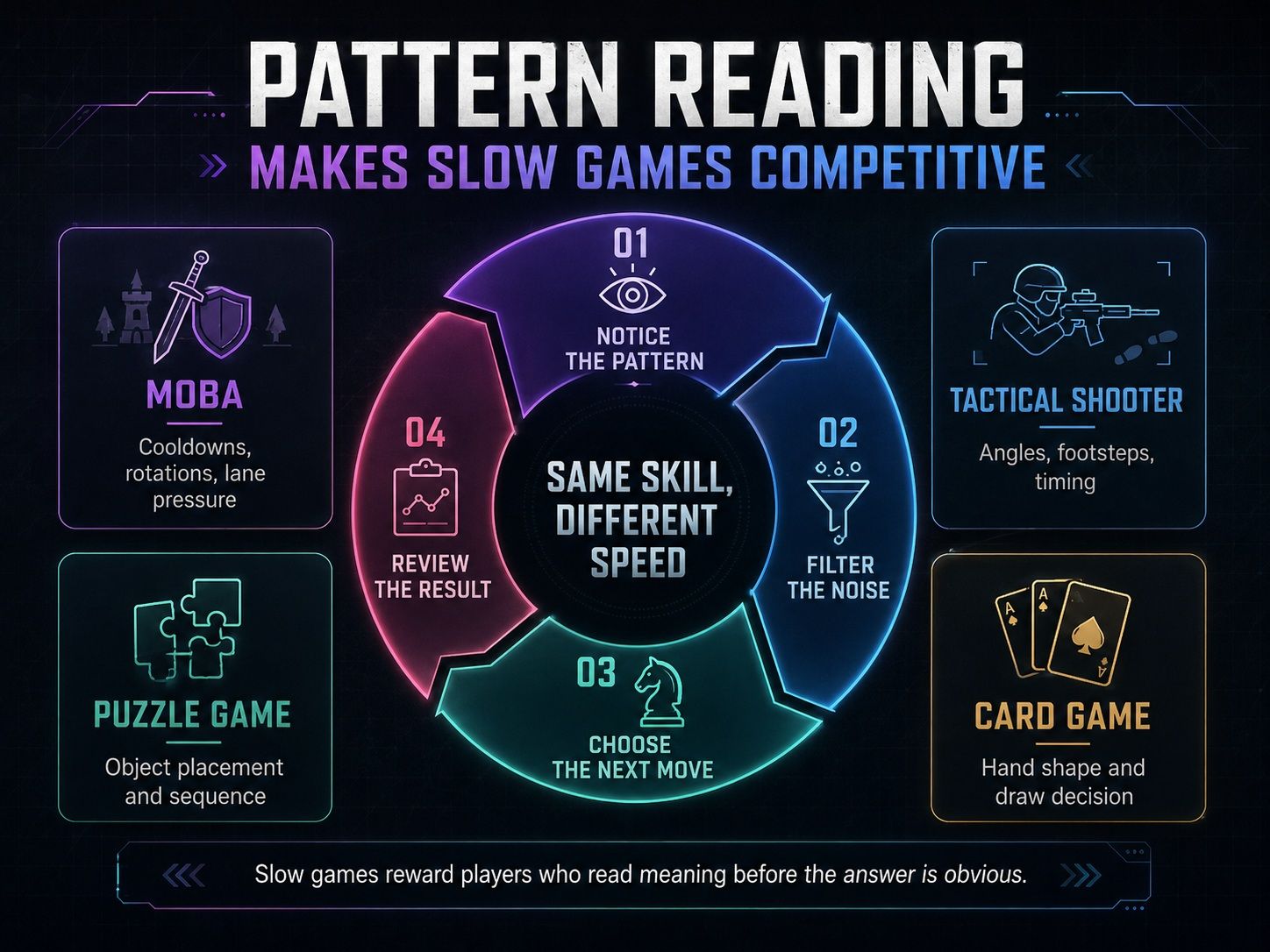
The easiest way to see this is to move away from the esports examples. In a MOBA, pattern reading means tracking cooldowns, map movement, lane states, and the timing of a fight. In a card-based format, the pattern is smaller and easier to isolate. The player gets dealt some cards, studies what the information available to them means, and then decides how to act.
This page of video poker online gives a clear example of that slower pattern loop because it explains video poker through a 5-card draw structure: receive 5 cards, choose which ones to hold, redraw replacements, then read the final hand through familiar poker rankings. At first, players tend to spend a while looking at the cards and searching for pairs and other combinations. With repetition, video poker players will be able to spot the most useful cards faster, and play will speed up.
After becoming more confident, many players will also want to check out the surrounding community layer so they can share and discuss their experiences with others. This Instagram post from Ignition Gaming points followers toward its Telegram for exclusive content and giveaways, which fits how modern game platforms often keep short-session players close to updates, reminders, and community prompts.
The Skill Is in What the Player Notices
A slow game gives the player more time to make their decisions, but that does not automatically make the decision simple. More time can actually make coming to a choice feel harder. There is less chaos to hide behind.
| Game Type | What The Player Reads | Why It Feels Competitive |
| MOBA | Cooldowns, rotations, lane pressure | The pattern changes every few seconds |
| Tactical shooter | Angles, footsteps, timing | One read can decide the next duel |
| Puzzle game | Object placement, sequence, space | Progress depends on spotting structure |
| Card game | Hand shape, draw potential, final outcome | The pressure sits inside a few focused choices |
This is why slow games can feel more personal than faster ones. A failed read is easy to replay in the mind. The player saw the same information the game offered, then selected one interpretation over another. Next time, the goal is not to move faster. It is to see the correct shape earlier.
Why Repetition Changes the Pattern
Players rarely learn a game by absorbing every rule at once. They learn through repeated contact with meaningful situations. First, they recognize the obvious patterns, and then gradually start spotting more subtle ones as well. Eventually, they start predicting the pattern before it has fully formed.
That learning curve appears across genres. A new League player may only see a champion walking into river. A better player sees missing vision, jungle timing, and the likely next fight. A puzzle player may first see loose objects, then later recognize a designed route. A card player may first see individual cards, then later recognize how the hand is asking to be shaped.
Slow Games Make Attention Visible
Fast games make skill look dramatic. Slow games make skill easier to study. They remove some of the noise and let the player see attention at work: what gets noticed, what gets ignored, what gets acted on, and what gets remembered after the result.
That is why slow games still belong in serious gaming discussions. They show that competition is not only about mechanical speed. It can also come from interpretation, patience, and repeated exposure to meaningful patterns. Whether the player is watching a minimap, studying a puzzle room, holding cards, or waiting for an enemy to appear, the core skill is similar: read the situation before it becomes obvious. That final idea is reinforced by research on timing, anticipation, repeated exposure, and how the mind prepares before action under pressure in implicit temporal processing in video game players.