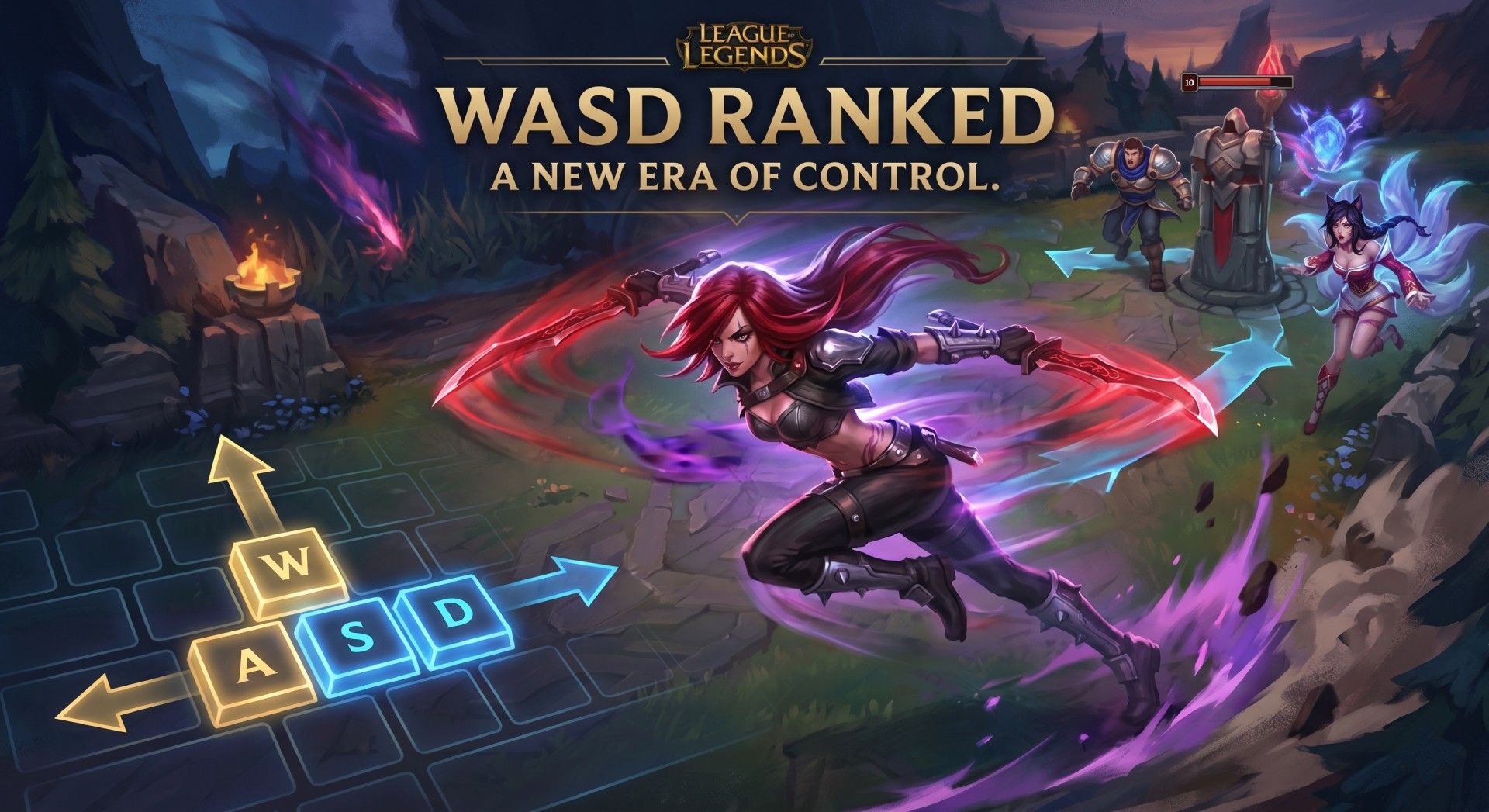
League of Legends WASD Ranked Release: What’s Changing and How to Prepare

If you learned PC games with keyboard movement, League’s click-to-move can still feel like the hardest mechanic in the first ten minutes. For players tracking the League of Legends WASD Ranked Release, the important point is that Riot Games is adding an optional input layer, not replacing classic hotkeys or mouse movement. This guide explains what launches in patch 26.9, how the controls actually work, and how to test them without donating LP.
What the WASD Ranked Release Actually Means
Riot Games said in its /dev: WASD's Ranked Release and related Dev Update messaging that WASD is an optional control scheme built around competitive integrity, not a forced redesign of League’s balance model. That matters because ranked fairness depends on preserving click-to-move as a valid standard while giving players another way to handle movement, camera behavior, and ability confirmation.
Who This Update Is For
This update primarily helps new or returning players who already understand PC action controls, locked cameras, and movement on keyboard instead of point-and-click controls. It also serves veterans who want accessibility improvements, less wrist strain, or a setup shaped by player feedback rather than one fixed control philosophy.
Release Timeline and Where WASD Is Available
Riot’s rollout has been staged: PBE testing first, then non-ranked modes, then ranked queues with patch 26.9 and Season 2. Early availability has centered on the Tutorial, ARAM, and rotating game modes because those environments expose bugs quickly without corrupting ranked data.
How to Verify It’s Live on Your Account
Check the client’s input menu for Keyboard (WASD) options, related camera settings, and any dynamic lock variants tied to movement. Then confirm your patch number and compare it with Riot patch notes, because regional deployment and client-side enablement can lag behind headline release timing.
How WASD Works in League: Core Mechanics Explained
With WASD enabled, keyboard inputs replace mouse pathing for champion movement, while the cursor still handles aiming, target selection, and many precision actions. Riot has paired that with confirm cast behavior, dynamic locked camera options, and champion-specific keybind customization so the system feels playable across different kits rather than only on simple champions.
Mouse Integration: What Still Uses the Cursor
Skillshots, target selection, and many attack decisions still rely on cursor accuracy, so WASD does not turn League into a twin-stick game. Riot’s customizable cursor movement matters here because sensitivity mismatches can create more missed inputs than movement errors, especially on champions that demand fast retargeting.
Ranked Readiness: What Riot Tested to Keep It Fair
Riot described Blind Experiential Analysis, Fine-Tuning for Ranked, and broader Ranked Readiness work as ways to compare input styles without bias from player expectation. The meaningful part is not just data analysis on win rates, but mechanical cleanup in wall navigation, tighter pathing around terrain, and Ability Attack Followup Logic that reduces awkward drops after a cast or auto.
What “Similar Performance Level” Means in Practice
A similar performance level does not mean every player will instantly perform the same on both schemes. It means Riot expects minimal average differences across large samples, while still monitoring edge cases such as marksmen kiting, high-APM skirmishes, or champions whose kits amplify camera and movement advantages.
Step-by-Step: Set Up WASD for Ranked Without Throwing Games
Start in Practice Tool or ARAM, because rebuilding movement and cursor coordination inside solo queue is the fastest way to misplay basic spacing. Set camera mode first, then lock in per-champion bindings for your mains, and finish by checking quick cast, target champions only, attack-move, and item-slot comfort before entering ranked.
Recommended Training Routine (30–60 Minutes)
Spend the first block last-hitting while strafing with WASD, then add camera adjustments, ward placement, and short trade patterns. Finish with dummy kiting drills that alternate move, attack, and ability confirms, because input reliability under pressure matters more than clean movement in an empty lane.
Champion and Role Impact: Where WASD Feels Better (or Worse)
Marksmen may feel immediate comfort gains in kiting rhythm, but cursor discipline still decides whether damage lands or drifts. Mages often benefit from smoother lane repositioning, assassins can chain movement naturally but still get punished for mis-aimed clicks, and supports or junglers may notice the biggest change in map checks, gank angles, and camera habits.
Examples to Mention (From Riot’s Coverage)
Aatrox and Ambessa highlight how melee spacing and sequencing can feel cleaner when movement is separated from cursor placement. Lux, Miss Fortune, and Qiyana show the opposite pressure point: repositioning can improve, but burst windows still depend on accurate aiming and clean confirm timing, which is why predicting movement in league of legends remains a core skill.
Common Mistakes Players Make When Switching to WASD
The biggest errors are over-locking the camera, forgetting to rebind attack-move, and using one generic setup across every champion. Most failed transitions are not caused by the scheme itself, but by untreated comfort issues like cursor speed, sensitivity, and key placement that increase fatigue and create avoidable miscasts.
Quick Fixes That Prevent LP Loss
Use one stable profile and change only one variable per session so you can identify what actually helped or hurt. Review a single replay after each test block, because camera errors and missed confirms are easier to fix than broad assumptions about the control scheme, and clean fundamentals matter more than extras like league of legends codes.
Key Takeaways and What to Watch After Launch
WASD in ranked is best understood as an onboarding and accessibility win, not a mandatory meta shift for established players. Patch 26.9 is the milestone, but follow-up tuning will likely target channeling, aiming, follow-up logic, champion-specific outliers, camera readability complaints, and further refinements to keybinding or joystick support.
Signals Riot May Adjust Next
If certain champions overperform only with keyboard movement, Riot will likely isolate those kits rather than declare the whole system unbalanced. From the Turbosmurfs perspective, the smartest response is simple: keep settings consistent, practice in measured blocks, and judge results by repeatable gameplay rather than novelty.
FAQ
Is WASD coming to ranked in LoL?
Yes. Riot confirmed the optional WASD control scheme is scheduled for ranked queues with patch 26.9.
Will LoL get WASD movement?
Yes. League of Legends is adding keyboard movement as an option alongside classic click-to-move, not as a replacement.
Is WASD in LoL available now?
Availability depends on patch timing and mode access. Riot tested it on PBE and select non-ranked modes before the ranked launch window.
Is WASD disabled in ranked LoL?
Before patch 26.9, ranked access may be restricted while Riot tests balance and input reliability. Once the rollout is live, it is intended to be available as an optional setting.