Two Gamers, One Game, Zero Agreement: The Efficiency Gap Explained

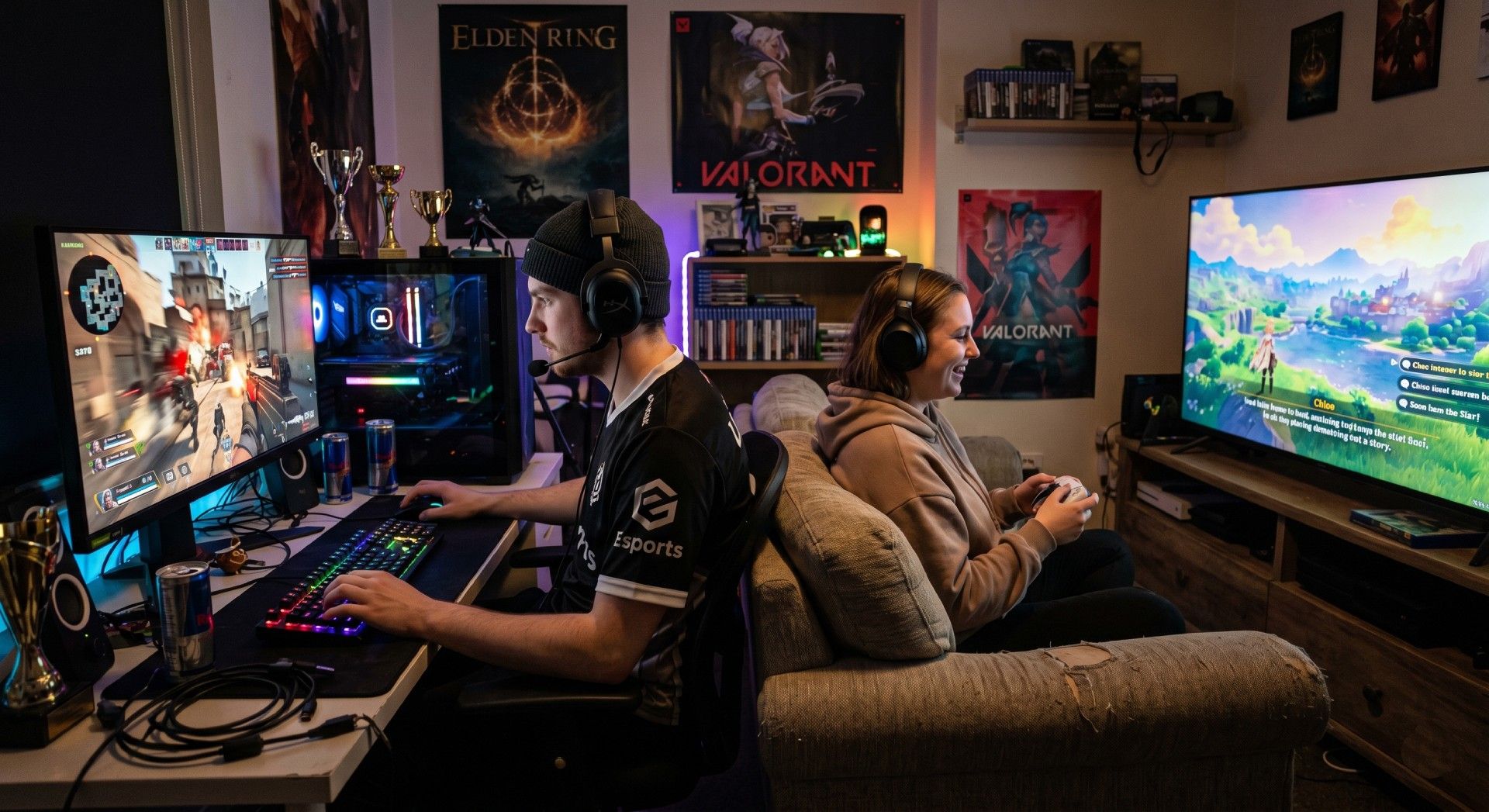
Gamers fall into one of two camps. One type is slow, embracing the story, reading the lore, and absorbing all the world-building subtleties. The other is goal-oriented and focused on playing with efficiency. They have routes mapped out and lose their cool when their playing partner carries a suboptimal loadout. You can’t change this, and it is integral to what makes the gaming community so vibrant. Like siblings, they bicker and fight, but end up back in the same lobby.
This efficiency gap is not limited to a few titles; it rears its head across every corner of the gaming world, from Battle Royale games and MMO raids to mobile gacha pulls and even casino bonus hunting. Understanding what type of player you are helps set expectations when playing with friends.
Playing for the Experience: The Casual Gamer’s Approach
Casual players view gaming as entertainment. They believe that games should be enjoyed rather than reverse engineered.
How They Play
A casual player is in no rush. They make selections based on feeling and intrigue. Their fighting game characters are the ones whose looks and attitudes resonate more than stats or move sets. Pokémon teams are built based on favorites rather than direct type matchups. Mobile games are there to pass the time now and then, and online slots are chosen because the game theme looks cool or appealing, with little regard for RTP rates.
Essentially, casual players want to have fun. They play games to have a good time, not because they want to be the best or beat the game and move on to the next. They create a more emotional connection with the games they choose.
What Drives Them
Casual gamers are motivated by enjoyment. They play games to experience them and have fun. Story and immersion trump progress for its own sake. Casual players typically have less time to play and want to ensure their time spent playing is relaxing. Gaming is used to relieve pressure, not to add to it.
Where This Fits (And Where It Doesn’t)
Not every player is a casual gamer, and by that same measure, not every game is well-suited to casual play. Casual players often enjoy story-driven RPGs, cozy games, sandbox titles such as Minecraft, and social MMOs where the core driver is cooperation rather than stat maxing. This is one area where casual and optimized players clash: as MMOs get deeper, raids become harder and more serious. This quickly becomes a friction point between the two types of gamers.
Playing the System: The Optimizer’s Approach
Optimization-focused players treat games as puzzles to be solved. There is one optimal way to conquer the game, and they are determined to find it. Often, they already know all about the game from the research they’ve done before playing it for the first time.
How They Play
Optimizers do their homework. They read reviews and patch notes. They study the characters, tiers, weapons, skill sets, and optimal progression pathways. Ready with damage calculators and stat spreadsheets, they know exactly what they need for any mission, raid, or specific chapter of a game. Speedrunners are an example of top-tier optimizers. They have notebooks filled with the best strats, key routes, and backup options. Optimized players in the online casino space operate the same way, often cross-referencing what CanadaCasino lists as the latest bonuses before signing up and committing to a given site.
What Drives Them
Optimizers are driven by figuring out the game as much as they are by playing and completing it. Story and immersion are secondary to the intellectual challenge of finding the best way to get from the start to the end. Beating the game is less about finishing the story than about beating the mechanics and getting to the end in a better way than the story-driven “casual” route.
Optimizers love sharing their successes, and there is status associated with uncovering new and improved routes or techniques. Optimizers tend to treat their games more as a project than a pastime.
Where This Fits (And Where It Doesn’t)
Optimization-driven players thrive when playing competitive titles such as looter shooters, strategy games, and those whose gameplay is dominated by mastery over story.
Narrative-heavy titles are not ideal and not often part of the optimization-focused gamer’s playlist. The same applies to sandbox games or those titles where the end is not really the end, but merely the beginning of the full open-world experience—think the Animal Crossing titles. Games that revolve around strategy, even cozy titles, can appeal to optimizers. Stardew Valley is a case in point, as evidenced by the numerous records and categories linked to the game on speedrun.com.
Why These Two Groups Clash
Both approaches to playing games are valid. However, the vastly different approaches often create friction when both types of gamers are playing in a shared space.
The Arguments You’ve Seen a Hundred Times
Collaborative efforts are a prime area for conflict. You and your friends team up to take down a big raid boss. You’ve done the homework; you know the loadouts each member of your guild/team needs to get the victory. But then, the casual gamers in your group arrive with a very different set of priorities, which is where the cracks start to appear.
Outside of gameplay itself, forums and gaming communities are rife with people in both camps who staunchly support their style as the only way to play a game. This leads to constant back-and-forth bickering, with both sides decrying, “That’s not how you play the game!”
The disconnects are driven by the fundamental mismatch in how games are viewed, and both sides are right and wrong in equal measure.
The Spectrum Is Real (And Most Players Live on It)
While players are split into these two camps, it is rare that someone sits at either extreme. A middle ground exists where motivations still contradict but devotion to the cause is more flexible.
How Most People Actually Play
Most gamers do not have spreadsheets tracking stats and optimal routes. However, many do play the same game over and over, with set routes and specific ideas for new things they wish to try with each playthrough.
Context is also an important and often overlooked factor. A time-limited event can quickly turn a casual gamer into an optimizer if the desire to obtain the reward outweighs the need to stay immersed in the narrative.
No game-play session is the same. Mood changes and time limits impact how a game is played, so an optimized gamer might not get the runs together they want and revert to exploring the level in the name of finding new things. Similarly, a casual gamer might push themselves to complete a chapter in a short session just because they need to progress, and in doing so sacrifice story for speed.
What to Take Away from This
Both types of players would benefit from research before diving in. A game filled with fishing and collectibles is better suited to a casual gamer. It will likely infuriate a gamer keen on finding a way through as quickly as possible. Likewise, a game that rejects exploration in the name of online rankings and build optimizations is unlikely to interest a casual player.
Some games appeal to both, such as Stardew Valley. Casual gamers can build relationships, grow crops, and master the small things along the way. At the same time, optimizers can sleep days away and only do what is necessary to complete certain aspects of the story.
The Gap Is Real, But It’s Not a Problem
The efficiency gap is one of the most long-standing fault lines among gaming communities. However, it is not a problem with games themselves or with gaming as a hobby. The conflict comes from the two camps occupying a shared space rather than any particular game itself.
Fortunately, the video game world is large and diverse enough to accommodate and cater to both types without having to pick a side or design games with one specific audience in mind.